
- By ccmadmin
- In Uncategorized
Bathroom Fixture Replacement: Costs, Fit and Who Should Do It
Bathroom fixture replacement is a simple job when you swap one faucet for another with the same hole spacing. It gets expensive when the new fixture does not match the plumbing behind the wall. The way to avoid that is to choose every fixture first and confirm what fits before anything is removed. If you are replacing two or more fixtures, or the room looks tired overall, a planned bathroom remodel usually costs less in rework than a string of separate swaps. In Virginia Beach, Chesapeake, Norfolk, Suffolk and Portsmouth, that is the work our bathroom remodels are built around.
TL;DR
- A faucet swap is a manageable job when the hole spacing matches. Toilets, tubs and anything that moves a drain or supply line are a different level of work.
- Fixture prices and installation labor are separate line items. Budget for both, and expect installed cost to run well above the sticker price.
- Pick fixtures before plumbing work starts. Late changes can pull in carpenters, drywallers and tile setters.
- Replacing several fixtures at once is the moment to look at the whole bathroom, including the vanity, flooring and tile.
- Military families can ask about our 10% Veteran or Active-Duty Discount when planning a remodel.
Table of Contents
- What counts as a bathroom fixture
- What bathroom fixture replacement costs
- Match the fixture to what is already in the wall
- What the DIY version involves
- How to tell a fixture needs replacing
- When a remodel beats separate swaps
- How our process handles bathroom fixtures
- Promo: plan the bathroom, not just the part
- Before you order anything: a short checklist
- FAQ
- Sources
What counts as a bathroom fixture
A fixture is anything that connects to your water supply or drain: the faucet, showerhead and shower valve, toilet, sink or vanity top, and tub. Some people also include towel bars, lighting and mirrors, but those do not involve plumbing and follow different rules.
That distinction matters because it sets the difficulty. Surface-mounted pieces such as a towel bar or a light cover are an afternoon. Plumbed fixtures involve shutoff valves, supply lines, seals and drains. A small mistake there shows up as a slow leak inside a cabinet or wall, and you may not see it for months.
What bathroom fixture replacement costs
Two numbers make up every quote: the price of the fixture and the price of installing it. They are often mixed up in online ranges, so keep them apart.
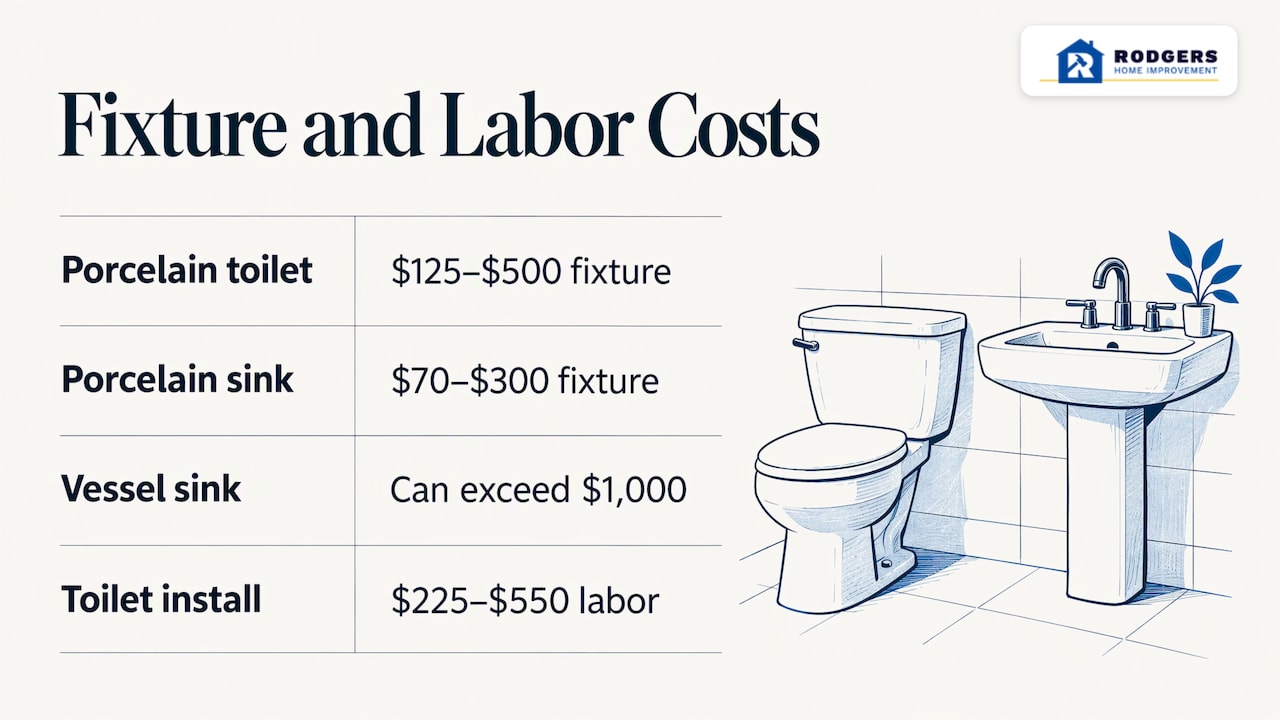
Fixture prices. Bob Vila’s small-bathroom cost guide puts basic porcelain toilets at roughly $125 to $500 and common porcelain bathroom sinks at $70 to $300. It notes that artisan-designed vessel sinks can pass $1,000. Those are product prices, not installed quotes.
Installation. The same guide lists toilet installation at $225 to $550, on top of the toilet itself. Labor for other fixtures varies with how accessible the plumbing is, how old the shutoff valves are and whether the drain has to change.
A worked example
Say you want a new toilet and a new bathroom sink. Using the Bob Vila ranges above, a mid-range case looks like this:
| Item | Low end | High end |
|---|---|---|
| Basic porcelain toilet | $125 | $500 |
| Toilet installation | $225 | $550 |
| Porcelain sink | $70 | $300 |
| Subtotal before faucet and sink labor | $420 | $1,350 |
That subtotal leaves out the faucet, the sink installation labor, the drain parts, any shutoff valve replacement and haul-away of the old pieces. It shows why a “quick fixture swap” quote deserves a line-by-line look.
We do not publish a price for bathroom remodels because every room is different. The consultation is where a fixture list becomes a real number for your bathroom.
Match the fixture to what is already in the wall
Most failed fixture replacements fail at the fit, not the install. A new faucet that does not line up with the sink holes, or a toilet whose drain sits in the wrong place, turns a one-hour job into a repair.
Faucets: measure the holes
This Old House’s faucet replacement guide tells you to remove the old faucet and measure the center-to-center distance between the outer sink holes. Six inches or more fits a widespread faucet. Closer spacing fits a centerset or mini-spread faucet. A centerset model fits three holes four inches apart, and a single-hole faucet can cover extra holes with a deck plate.
The quick rule: count the holes, measure the spacing, and buy to match. Choosing by finish first and checking the holes second is how people end up returning boxes.
Toilets and sinks: know your rough-in
The rough-in is the position of the supply and drain pipes before the fixture goes on. A fixture only fits if its connections line up with those pipes. Brad Casebier, a plumbing contractor in Austin, Texas, writes in Fine Homebuilding that the safest approach is to select bath fixtures before plumbing work starts, and to follow each fixture’s manufacturer cut sheet, which is the dimension drawing that ships with or is published for the product. He also says typical rough-in dimensions work for most entry- to mid-level fixtures, so the trouble tends to come from specialty pieces and from changing your mind late.
Those late changes are costly. He notes they can involve carpenters, drywallers and tile setters, with costs running from hundreds to thousands of dollars, plus delays.
Check the finishes and the whole set
Mixing finishes across a faucet, showerhead, towel bars and cabinet hardware is where bathrooms start to look unplanned. Decide on one finish family and one style (traditional, transitional, modern) before you order anything. Order everything together so batch and color differences do not show up in the finished room.
What the DIY version involves
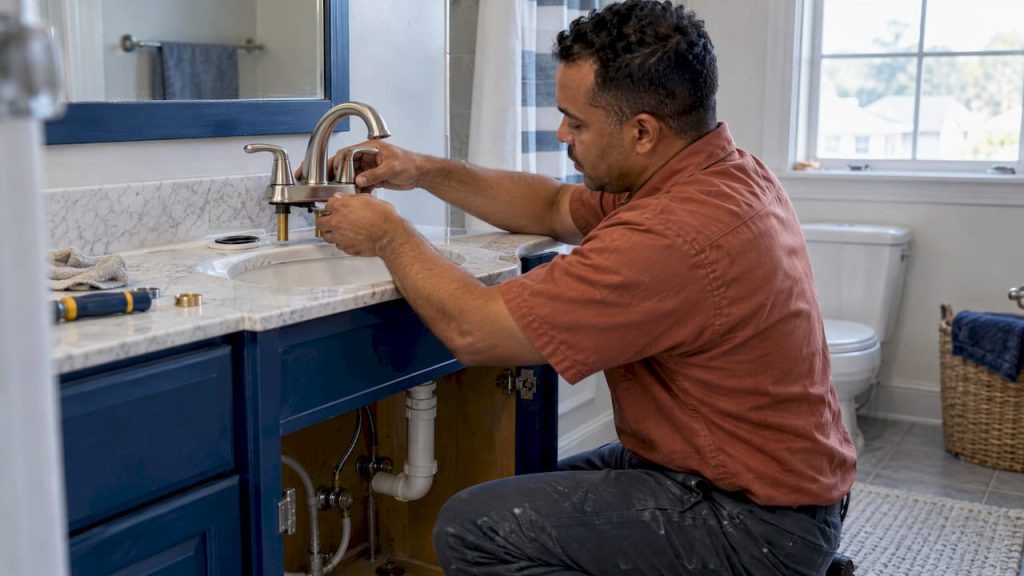
Some homeowners want to handle a faucet swap themselves, and it helps to see what the job actually takes so you can judge it honestly.
The This Old House guide and its plumbing and heating expert Richard Trethewey stress that the most important step is shutting the water off first. They also warn against over-torquing old shutoff valves, because the pipe behind the wall may not be well secured. A valve that turns hard or weeps when touched is a sign to stop.
The general sequence for a faucet looks like this:
- Clear the cabinet under the sink and set out a bucket and rags.
- Close the hot and cold shutoff valves, then open the faucet to relieve pressure.
- Disconnect the supply lines and remove the mounting nuts, which usually needs a basin wrench because of the tight space.
- Clean the sink surface where the old faucet sat.
- Set the new faucet, tighten the connections firmly without over-tightening, and reconnect the lines.
- Turn the water on slowly, flush the lines, and check for leaks above and below the sink.
Toilets add more steps: removing the old unit, replacing the wax seal and setting the new bowl without cracking the porcelain. Tubs and shower valves involve opening walls. Those are not first-time jobs.
Whatever you take on, follow the manufacturer’s instructions for your specific model and your local plumbing code. If anything is unclear, such as a corroded valve, a pipe that moves, or a leak you cannot trace, stop and bring in a qualified professional before the water goes back on.
How to tell a fixture needs replacing
There is no fixed lifespan for a faucet or toilet. Replace based on condition and on what the fixture is costing you. These signs are the usual reasons:
- Persistent drips after you have changed washers or cartridges.
- Mineral buildup or corrosion that cleaning no longer removes.
- Loose or wobbling handles and bases that keep coming back after tightening.
- Cracks, chips or worn finish on sinks, tubs and toilet bowls, since damaged surfaces collect grime and can leak.
- A toilet that rocks or leaks at the base, which can point to a failed seal or a damaged flange.
- Style or function you no longer want, such as a pedestal sink in a room that needs storage.
Water under a sink cabinet, soft flooring near the toilet, or stains on the ceiling below a bathroom deserve prompt attention. Moisture left in place damages subfloors and cabinets, and that is a bigger repair than the fixture.
When a remodel beats separate swaps
If a single faucet is leaking, replace the faucet. If you are looking at the faucet, the toilet, the vanity and a worn floor all at once, treating them as four small jobs tends to cost more than one planned project. Here is why.
The access is already open. Replacing a vanity or toilet exposes the supply lines, shutoff valves and flooring edge. That is the cheapest moment to renew old valves and supply lines, and to fix the floor that has been hidden under the toilet for years.
Fit is settled once. Casebier’s point about selecting fixtures before plumbing work starts is the heart of a remodel process. When fixtures, vanity, tile and flooring are chosen together, the dimensions are checked together and surprises are caught on paper.
One schedule, one point of contact. Several separate jobs mean several visits and several chances for the work to overlap badly. A remodel sequences the trades in order.
Property investors get the same logic with a resale or rental angle: matching fixtures, one finish family and durable flooring present better than a mix of replaced and original parts.
First-time homeowners often inherit a bathroom with unknown plumbing history. A guided consultation helps you decide what is worth replacing now and what can wait.
How our process handles bathroom fixtures
Our work runs in four steps: consultation, design, planning and construction. For a bathroom, that order is what keeps fixture decisions from becoming surprises.
- Consultation. We look at the room you have and what you want from it.
- Design. Layout, fixtures, finishes and surfaces get chosen together.
- Planning. The selections are locked in before construction starts, which is the sequencing Casebier recommends for avoiding late changes.
- Construction. The work is carried out with the plan already settled.
We are a local, veteran-owned company with a local showroom, and we offer a wider range of options for cabinets, countertops, tile and flooring. That range is useful when a new vanity and new fixtures need to look like they belong together with the floor and walls.
Promo: plan the bathroom, not just the part
If you are weighing a fixture replacement and the room keeps asking for more, our bathroom remodels service covers the whole room, from fixtures to surfaces, through the same four steps. Flooring changes can be part of it through our flooring service.

Military families can ask about our 10% Veteran or Active-Duty Discount when they book a consultation. If a kitchen is also on your list, our kitchen remodels follow the same process, and we can do an entire kitchen renovation in as little as 3 weeks, not counting scheduling.
Before you order anything: a short checklist
- Write down every fixture you want to replace and which ones are plumbed.
- Measure faucet hole spacing and note whether the sink has one, three or more holes.
- Find the toilet’s rough-in distance and the location of the supply and drain pipes.
- Test the shutoff valves gently. If one is stiff, leaks or is corroded, plan to replace it rather than force it.
- Choose one finish and one style for faucet, shower trim and hardware.
- Download or save each product’s dimension sheet before you buy.
- Decide whether the room needs more than fixtures. If it does, plan it as one project.
FAQ
How much does it cost to replace bathroom fixtures?
It depends on which fixtures and how hard the install is. Bob Vila’s guide lists basic porcelain toilets at about $125 to $500, with installation at $225 to $550 on top, and porcelain sinks at about $70 to $300. Add faucets, drain parts, valve replacement and any repair behind the wall to reach a realistic installed figure.
Are bathroom fixtures easy to replace?
A faucet with matching hole spacing and working shutoff valves is within reach for many homeowners. Toilets, tubs and shower valves are harder because of seals, weight and wall access. If the shutoff valves will not close fully or the pipe moves when you turn a wrench, stop and bring in a qualified professional.
How do I know which faucet fits my sink?
Remove the old faucet and measure the center-to-center distance of the outer holes. Six inches or more fits a widespread faucet, and closer spacing fits a centerset or mini-spread faucet, according to This Old House. A single-hole faucet can cover extra holes with a deck plate.
Should I replace one fixture or remodel the whole bathroom?
Replace one if only one is failing and the rest of the room is in good shape. If you are replacing several fixtures or the vanity and floor are also worn, one planned project avoids paying for access and sequencing more than once. Our consultation is the place to talk it through.
Sources
- How Much Does a Small Bathroom Remodel Cost? (Bob Vila)
- How to Replace a Bathroom Faucet (This Old House)
- Rough-in guidance by Brad Casebier (Fine Homebuilding)


